
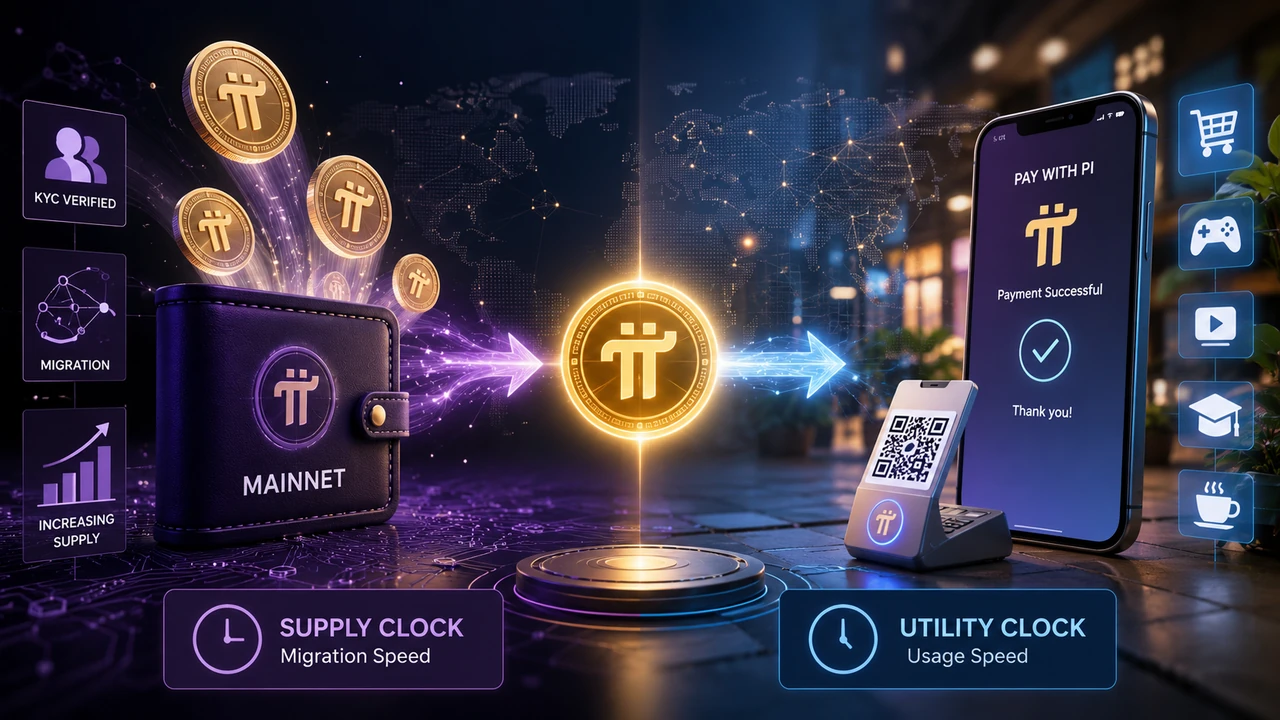
A PI price alert at $0.12 would be notable, but it would not by itself prove a durable breakout. The more useful test is whether transferable Mainnet supply is being absorbed while real ecosystem usage grows at the same time. Official 2026 Pi Network updates give us concrete migration, validator-reward, and app-payment milestones—but important usage metrics are still missing.
Quick Summary
A traded price and a durable support level are not the same thing. For a volatile crypto asset, the quality of a move depends on how long the level holds, whether volume is broad rather than concentrated, and whether fresh demand can absorb available supply. A $0.12 print is therefore better treated as a checkpoint.
1. Treat $0.12 as a test zone, not a finish line
A traded price and a durable support level are not the same thing. For a volatile crypto asset, the quality of a move depends on how long the level holds, whether volume is broad rather than concentrated, and whether fresh demand can absorb available supply. A $0.12 print is therefore better treated as a checkpoint.
2. Supply clock: second migrations expand user choice
Pi Network announced the gradual rollout of second migrations on March 14, 2026. By March 26, it reported that more than 119,000 Pioneers had completed second migrations. Eligible balances can include additional transferable Pi and referral mining bonuses tied to Referral Team members who fully passed KYC, while first migrations continue to receive priority. Migrated Pi is not automatically sell pressure, but it gives holders more options to hold, spend, transfer, or potentially move funds to external markets.
3. Validator rewards show utility—and create liquid balances
At the March 5, 2026 snapshot, Pi Network reported 526,970,631 successful human validation tasks completed by 1,094,680 validators. The first reward pool combined 16,568,774 Pi associated with migrated Pioneers and a 10 million Pi Foundation contribution, producing an official rate of about 0.0504179 Pi per successful validation. This is a concrete case of Pi compensating human work, but distributed rewards can later be held, spent, or transferred.
4. Utility clock: Mainnet payments moved from concept to infrastructure
Pi Day 2026 brought Mainnet support and live Pi payment integration to qualifying Pi App Studio apps, with four apps initially invited to transition. The release also enabled payment interactions that can persist across sessions, allowing purchased access or upgrades to remain available when a user returns. That improves the infrastructure for durable app businesses, but infrastructure is not the same as proven demand.
5. The missing metrics matter most now
Public updates do not yet provide a complete ecosystem-wide picture of paying users, total Pi spent in Mainnet apps, repeat-purchase rates, or retention. Those figures would help distinguish a payment feature from an active payment economy. App counts alone are less informative than users who pay for something useful and come back.
6. Four checks after a $0.12 alert
Watch whether the price holds rather than merely touches the level; whether trading activity is spread across multiple meaningful markets; whether buy-side liquidity absorbs newly movable balances; and whether payment, repeat-use, or retention metrics improve. Order books change quickly, so a single snapshot should never be treated as a permanent market structure.
7. What a stronger vs. weaker setup looks like
A stronger setup would combine rising transferable supply with stable price action, diversified market liquidity, and growing real app usage. A weaker setup would show a brief price spike, concentrated trading, and little evidence of repeat ecosystem spending. The point is not to predict a guaranteed outcome, but to judge the quality of the move.
8. Bottom line: watch absorption and repeat usage
The most meaningful question is not whether PI can print $0.12 once. It is whether markets and apps can absorb more transferable Pi while users repeatedly choose to spend Pi for useful services. This article is informational, not investment advice; crypto prices, volume, and order books can change rapidly.
| Signal | Stronger evidence | Warning sign |
|---|---|---|
| Price behavior | Holds near/above $0.12 over time | Brief spike followed by fast rejection |
| Liquidity | Volume spread across meaningful markets | Heavy concentration in a few venues |
| Migration | More movable Pi without destabilizing liquidity | Newly movable balances coincide with sharp selling |
| Utility | Growing payments, repeat users and retention | Feature launches without measurable usage |
Checklist
- Measure how long $0.12 holds, not just whether it trades once.
- Check whether volume is diversified across major markets.
- Follow second-migration updates from Pi Network itself.
- Look for disclosed payment volume, repeat users and retention.
- Keep market snapshots separate from slower-moving ecosystem milestones.
Practical Tip
Use Pi Network’s official posts for product and migration status, and a market-data provider such as CoinGecko for live price and volume. They answer different questions.
Caution
Do not assume every migrated PI will be sold, and do not assume payment functionality automatically means high payment demand. Neither conclusion is supported by the available public data.
FAQ
Does PI reaching $0.12 confirm a new bull trend?
No. A single price print does not confirm a durable trend. Holding time, liquidity, market concentration and real ecosystem usage provide more context.
Will second migrations automatically create selling pressure?
Not automatically. Migrated Pi can be held, spent, transferred, or moved elsewhere. The relevant question is whether demand and liquidity can absorb the additional movable balance.
Are KYC validator rewards a real Pi utility case?
Yes. Pi Network calculated and distributed rewards for successful human KYC validation work in Pi. Those rewards also become balances that recipients can later hold, use, or transfer.
Can Pi App Studio apps accept real Mainnet Pi payments?
According to the Pi Day 2026 release, qualifying App Studio apps can transition to Mainnet and integrate live Pi payments. That does not by itself establish the total scale of payment activity.
What should I track for a Pi Network price outlook?
Track a combination of transferable supply, liquidity distribution, actual app payments, repeat usage or retention, and how long key price levels hold. No single metric is sufficient.
Sources & Update Checks
- Pi Day 2026 — second migrations, validator rewards, Mainnet App Studio payments
- Second Migrations and Referral Bonus Migrations
- Pi’s Human Infrastructure for AI
- Pi App Studio backend updates
- CoinGecko — Pi Network market data
Final Takeaway
The most meaningful question is not whether PI can print $0.12 once. It is whether markets and apps can absorb more transferable Pi while users repeatedly choose to spend Pi for useful services. This article is informational, not investment advice; crypto prices, volume, and order books can change rapidly.